Methods › Natural Language Processing › Text Data Augmentation › DART
DART
archive 2025-07-28 Description, source and code snippet are the archive's method entry.
🎯 DART-Math
Difficulty-Aware Rejection Tuning for Mathematical Problem-Solving
📝 Paper@arXiv | 🤗 Datasets&Models@HF | 🐱 Code@GitHub
🐦 Thread@X(Twitter) | 🐶 中文博客@知乎 | 📊 Leaderboard@PapersWithCode | 📑 BibTeX
Datasets: DART-Math
DART-Math datasets are the state-of-the-art and data-efficient open-source instruction tuning datasets for mathematical reasoning.
DART-Math-Hard contains \~585k mathematical QA pair samples constructed by applying DARS-Prop2Diff to the query set from MATH and GSK8K training sets, achieves SOTA on many challenging mathematical reasoning benchmarks. It introduces a deliberate bias towards hard queries, opposite to vanilla rejection sampling.
Performance produced by DART-Math-Hard is usually but not necessarily slightly better (\~1% absolutely) than DART-Math-Uniform, which contains \~591k samples constructed by applying DARS-Uniform.
Comparison between Mathematical Instruction Tuning Datasets
Most of previous datasets are constructed with ChatGPT, and many of them are not open-source, especially for ones of the best performance.
| Math SFT Dataset | # of Samples | MATH | GSM8K | College | Synthesis Agent(s) | Open-Source |
|---|---|---|---|---|---|---|
| WizardMath | 96k | 32.3 | 80.4 | 23.1 | GPT-4 | ✗ |
| MetaMathQA | 395k | 29.8 | 76.5 | 19.3 | GPT-3.5 | ✓ |
| MMIQC | 2294k | 37.4 | 75.4 | 28.5 | GPT-4+GPT-3.5+Human | ✓ |
| Orca-Math | 200k | -- | -- | -- | GPT-4 | ✓ |
| Xwin-Math-V1.1 | 1440k | 45.5 | 84.9 | 27.6 | GPT-4 | ✗ |
| KPMath-Plus | 1576k | 46.8 | 82.1 | -– | GPT-4 | ✗ |
| MathScaleQA | 2021k | 35.2 | 74.8 | 21.8 | GPT-3.5+Human | ✗ |
DART-Math-Uniform |
591k | 43.5 | 82.6 | 26.9 | DeepSeekMath-7B-RL | ✓ |
DART-Math-Hard |
585k | 45.5 | 81.1 | 29.4 | DeepSeekMath-7B-RL | ✓ |
MATH and GSM8K are in-domain, while College(Math) is out-of-domain. Performance here are of models fine-tuned from Mistral-7B, except for Xwin-Math-V1.1 based on Llama2-7B. Bold/Italic means the best/second best score here.
Dataset Construction: DARS - Difficulty-Aware Rejection Sampling
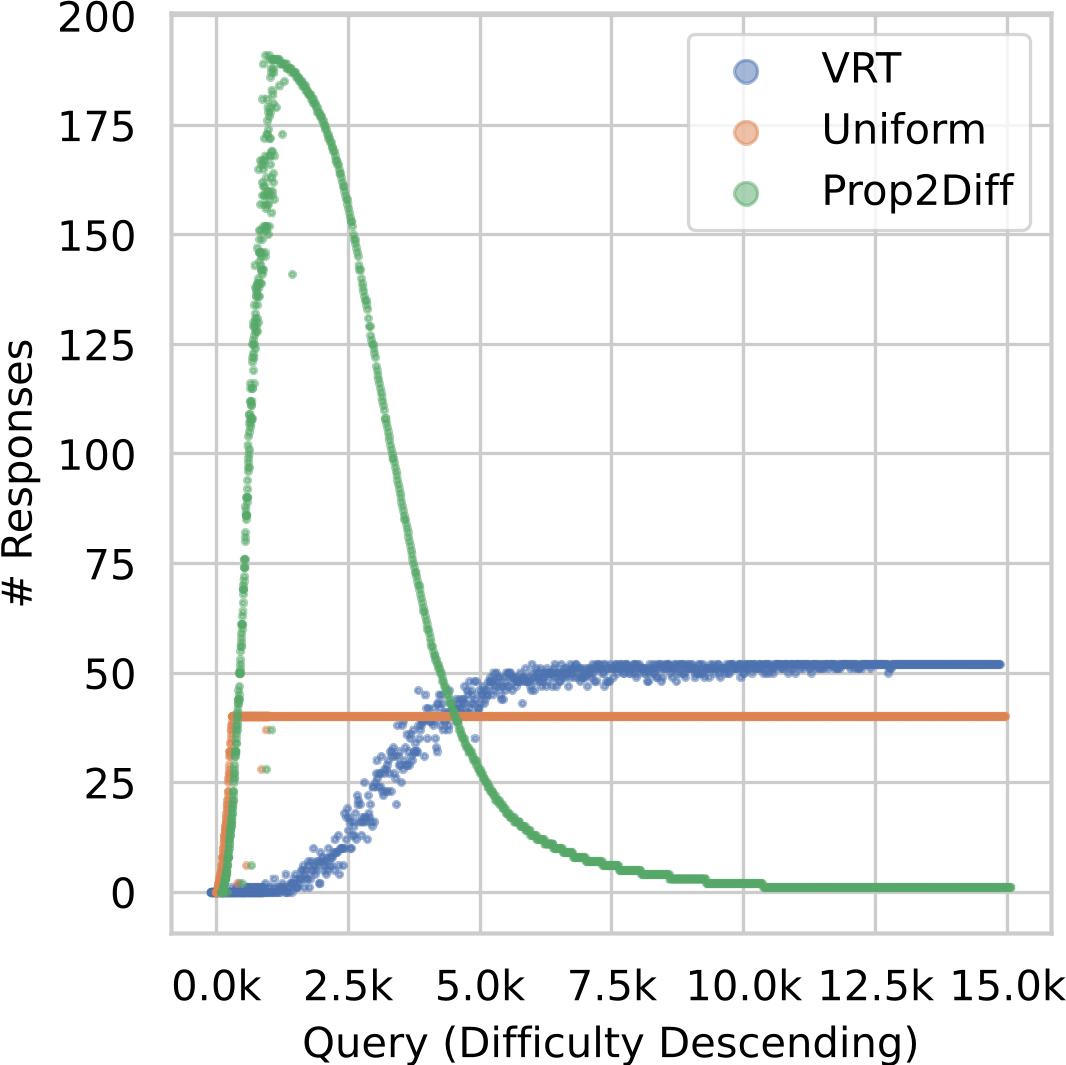
Previous works usually synthesize data from proprietary models to augment existing datasets, followed by instruction tuning to achieve top-tier results. However, our analysis of these datasets reveals severe biases towards easy queries, with frequent failures to generate any correct response for the most challenging queries.
Motivated by the observation above, we propose to Difficulty-Aware Rejection Sampling (DARS), to collect more responses for more difficult queries.
Specifically, we introduce two strategies to increase the number of correct responses for difficult queries:
1) Uniform, which involves sampling responses for each query until each query accumulates kᵤ correct responses, where kᵤ is a preset hyperparameter determined by the desired size of the synthetic dataset; 2) Prop2Diff, where we continue sampling responses until the number of correct responses for each query is proportional to its difficulty score. The most challenging queries will receive kₚ responses and kp is a hyperparameter. This method introduces a deliberate bias in the opposite direction to vanilla rejection sampling, towards more difficult queries, inspired by previous works that demonstrate difficult samples can be more effective to enhance model capabilities (Sorscher et al., 2022; Liu et al., 2024b).
See Figure 1 (Right) for examples of DART-Math-Uniform by DARS-Uniform and DART-Math-Hard by DARS-Prop2Diff.
Citation
If you find our data, model or code useful for your work, please kindly cite our paper:
@article{tong2024dartmath,
  title={DART-Math: Difficulty-Aware Rejection Tuning for Mathematical Problem-Solving},
  author={Yuxuan Tong and Xiwen Zhang and Rui Wang and Ruidong Wu and Junxian He},
  year={2024},
  eprint={2407.13690},
  archivePrefix={arXiv},
  primaryClass={cs.CL},
  url={https://arxiv.org/abs/2407.13690},
}
Papers archive 2025-07-28
30 shown of 32, newest first. Repository counts are the archive's code-links table. A Syntology line states what Syntology ran from that paper's harvested code; it is per sample and not a correctness claim.
-
DART: Distilling Autoregressive Reasoning to Silent Thought 13 Jun 2025 · 0 repositories · arXiv:2506.11752
-
DART: Differentiable Dynamic Adaptive Region Tokenizer for Vision Transformer and Mamba 12 Jun 2025 · 1 repository · arXiv:2506.10390
-
TablePilot: Recommending Human-Preferred Tabular Data Analysis with Large Language Models 17 Mar 2025 · 0 repositories · arXiv:2503.13262
-
dARt Vinci: Egocentric Data Collection for Surgical Robot Learning at Scale 7 Mar 2025 · 0 repositories · arXiv:2503.05646
-
Stop Looking for Important Tokens in Multimodal Language Models: Duplication Matters More 17 Feb 2025 · 1 repository · arXiv:2502.11494Syntology ran 7 of 8 samples · 1 unverified
-
Text-Diffusion Red-Teaming of Large Language Models: Unveiling Harmful Behaviors with Proximity Constraints 14 Jan 2025 · 0 repositories · arXiv:2501.08246
-
Iterative Encoding-Decoding VAEs Anomaly Detection in NOAA's DART Time Series: A Machine Learning Approach for Enhancing Data Integrity for NASA's GRACE-FO Verification and Validation 20 Dec 2024 · 0 repositories · arXiv:2412.16375
-
From Point to probabilistic gradient boosting for claim frequency and severity prediction 19 Dec 2024 · 0 repositories · arXiv:2412.14916
-
DART: An AIGT Detector using AMR of Rephrased Text 16 Dec 2024 · 0 repositories · arXiv:2412.11517
-
An Extensive Evaluation of Factual Consistency in Large Language Models for Data-to-Text Generation 28 Nov 2024 · 0 repositories · arXiv:2411.19203
-
Label Distribution Shift-Aware Prediction Refinement for Test-Time Adaptation 20 Nov 2024 · 0 repositories · arXiv:2411.15204
-
Jal Anveshak: Prediction of fishing zones using fine-tuned LlaMa 2 15 Nov 2024 · 0 repositories · arXiv:2411.10050
-
DART: Denoising Autoregressive Transformer for Scalable Text-to-Image Generation 10 Oct 2024 · 0 repositories · arXiv:2410.08159
-
DartControl: A Diffusion-Based Autoregressive Motion Model for Real-Time Text-Driven Motion Control 7 Oct 2024 · 0 repositories · arXiv:2410.05260
-
DiSK: Differentially Private Optimizer with Simplified Kalman Filter for Noise Reduction 4 Oct 2024 · 0 repositories · arXiv:2410.03883
-
Impact of Model Size on Fine-tuned LLM Performance in Data-to-Text Generation: A State-of-the-Art Investigation 19 Jul 2024 · 0 repositories · arXiv:2407.14088
-
DART: An Automated End-to-End Object Detection Pipeline with Data Diversification, Open-Vocabulary Bounding Box Annotation, Pseudo-Label Review, and Model Training 12 Jul 2024 · 1 repository · arXiv:2407.09174
-
Automated Progressive Red Teaming 4 Jul 2024 · 1 repository · arXiv:2407.03876
-
DART-Math: Difficulty-Aware Rejection Tuning for Mathematical Problem-Solving 18 Jun 2024 · 1 repository · arXiv:2407.13690Syntology ran 10 of 12 samples · 2 unverified
-
Learning to Play Atari in a World of Tokens 3 Jun 2024 · 0 repositories · arXiv:2406.01361
-
WASH: Train your Ensemble with Communication-Efficient Weight Shuffling, then Average 27 May 2024 · 0 repositories · arXiv:2405.17517
-
Control-DAG: Constrained Decoding for Non-Autoregressive Directed Acyclic T5 using Weighted Finite State Automata 10 Apr 2024 · 1 repository · arXiv:2404.06854
-
Empowering Image Recovery_ A Multi-Attention Approach 6 Apr 2024 · 0 repositories · arXiv:2404.04617
-
Matrix-Transformation Based Low-Rank Adaptation (MTLoRA): A Brain-Inspired Method for Parameter-Efficient Fine-Tuning 12 Mar 2024 · 0 repositories · arXiv:2403.07440
-
Applicability of oculomics for individual risk prediction: Repeatability and robustness of retinal Fractal Dimension using DART and AutoMorph 11 Mar 2024 · 0 repositories · arXiv:2403.06950
-
DART: Implicit Doppler Tomography for Radar Novel View Synthesis 6 Mar 2024 · 0 repositories · arXiv:2403.03896
-
DART: Depth-Enhanced Accurate and Real-Time Background Matting 24 Feb 2024 · 0 repositories · arXiv:2402.15820
-
DART: A Principled Approach to Adversarially Robust Unsupervised Domain Adaptation 16 Feb 2024 · 0 repositories · arXiv:2402.11120
-
Gazebo Plants: Simulating Plant-Robot Interaction with Cosserat Rods 4 Feb 2024 · 0 repositories · arXiv:2402.02570
-
Self-training from Self-memory in Data-to-text Generation 19 Jan 2024 · 1 repository · arXiv:2401.10567
Tasks archive 2025-07-28
20 shown of 55 tasks the archive attaches to papers tagged with this method, by distinct papers. A task without a page in the catalog is plain text.
Usage over time archive 2025-07-28
Components: the archive holds no method-to-method composition, so PwC's Components table cannot be rebuilt; the Papers list carries no Results column for the same reason (the archive does not join its leaderboard rows to method tags).
Categories archive 2025-07-28
Report a problem or propose a change · a person checks every report against the paper or source before anything changes; decisions are listed on /corrections